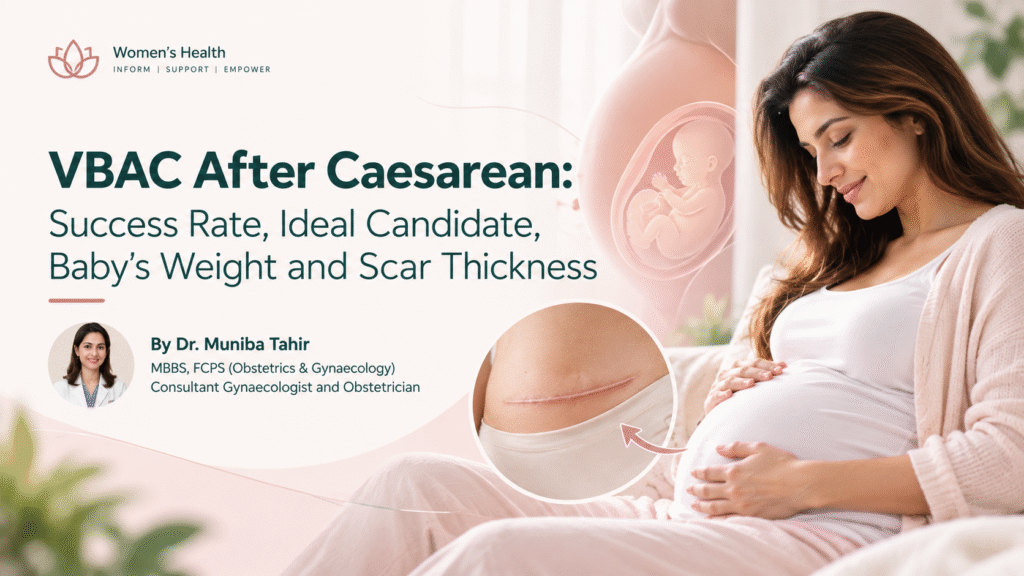
A previous caesarean section does not automatically mean that every future delivery must also be by caesarean.
According to the American College of Obstetricians and Gynecologists (ACOG) and the Royal College of Obstetricians and Gynaecologists (RCOG), vaginal birth after caesarean can be a clinically safe option for most appropriately selected women with one previous lower-segment caesarean.
However, VBAC should be planned only after reviewing the previous operation, the reason for the caesarean, the present pregnancy and the hospital’s ability to perform an immediate emergency caesarean if required.
What Is the Difference Between TOLAC and VBAC?
TOLAC means Trial of Labour After Caesarean. It refers to the planned attempt to labour and deliver vaginally after a previous caesarean.
VBAC means Vaginal Birth After Caesarean. It describes a successful vaginal delivery following that trial of labour.
Therefore, every planned VBAC begins as a TOLAC, but not every trial ends in vaginal birth.
What Is the VBAC Success Rate?
RCOG reports that approximately 72–75%, or around three out of four appropriately selected women, achieve vaginal delivery after one previous caesarean when the pregnancy is straightforward and labour begins naturally.
The success rate increases to approximately 85–90% in women who have previously delivered vaginally, especially those with a previous successful VBAC.
Approximately one in four women attempting VBAC may require an emergency caesarean during labour. RCOG patient guidance
Who Is an Ideal Candidate for VBAC?
The most favourable candidate generally has:
- One previous lower-segment transverse caesarean
- A single baby in a head-down position
- A straightforward present pregnancy
- No contraindication to vaginal birth
- A previous vaginal delivery or successful VBAC
- A non-recurrent reason for the previous caesarean
- Spontaneous onset of labour
- A booking BMI below 30
- An appropriately grown baby
- An adequate interval between pregnancies
- No history of uterine rupture
- No major surgery involving the upper uterine muscle
- Access to continuous fetal monitoring and immediate emergency caesarean delivery
The previous caesarean operation notes should be obtained whenever possible. The direction of the scar on the skin does not reliably indicate the type of incision made on the uterus.
Favourable Factors for VBAC Success
Previous vaginal birth
A previous vaginal delivery, particularly a previous successful VBAC, is the strongest predictor of success. It is also associated with a lower risk of uterine rupture.
Non-recurrent indication for the first caesarean
Success is more likely when the previous caesarean was performed for a problem unlikely to recur, such as:
- Breech presentation
- Placenta previa in the previous pregnancy
- Non-reassuring fetal heart rate
- A temporary maternal or fetal complication
Previous caesarean for delayed labour progress does not automatically exclude VBAC, but the previous labour record should be reviewed.
Spontaneous labour
Natural onset of labour improves the chance of success and is associated with a lower scar-rupture risk than induction.
Favourable cervix
A soft, shortened and partially dilated cervix at the onset of labour or induction increases the probability of vaginal delivery.
BMI below 30
RCOG identifies a booking BMI below 30 as a favourable factor. A BMI above 30 reduces the statistical probability of success but is not, by itself, a contraindication.
Baby in a head-down position
VBAC is most straightforward when there is one baby in cephalic presentation.
Adequate pregnancy interval
A longer interval after the previous caesarean is generally favourable. A short interval—particularly delivery less than approximately 18 months after the previous birth—requires individualised counselling because some evidence suggests an increased rupture risk.
Unfavourable Factors
The following factors may reduce the probability of VBAC success:
- No previous vaginal delivery
- Previous caesarean for labour dystocia or arrest
- Previous unsuccessful TOLAC
- Maternal age of 40 years or above
- Booking BMI of 30 or above
- Pregnancy beyond 40 weeks
- Labour induction
- Unfavourable cervix
- Need for oxytocin augmentation
- Suspected large baby
- Diabetes
- Hypertension or pre-eclampsia
- Short interdelivery interval
- Baby’s head remaining high at the onset of labour
- More than one previous caesarean
These are risk modifiers rather than automatic contraindications. The complete clinical picture matters more than one isolated factor.
How Much Fetal Weight Is Acceptable for VBAC?
This is one of the most frequently asked questions, but ACOG and RCOG do not define one absolute estimated fetal-weight limit above which VBAC is always prohibited.
The important 4-kg threshold
RCOG advises that a birth weight of 4,000 g or more is associated with:
- Lower VBAC success
- Increased likelihood of uterine rupture
- Increased risk of shoulder dystocia
- Increased risk of severe perineal trauma
The concern is greater when the woman has never delivered vaginally.
RCOG cites evidence that among women with no previous vaginal delivery, an actual neonatal birth weight of 4 kg or more was associated in one study with:
- VBAC success below 50%
- Uterine rupture rate of approximately 3.6%
These figures should be interpreted cautiously because they refer to the baby’s actual birth weight, which is known only after delivery.
Is an estimated weight above 4 kg a contraindication?
No. Suspected macrosomia alone does not automatically exclude TOLAC under ACOG guidance. It should instead prompt individual counselling.
The decision should also consider:
- Previous vaginal delivery
- Previous successful VBAC
- Maternal diabetes
- Maternal height and pelvic assessment
- Previous baby’s birth weight and mode of delivery
- Reason for the previous caesarean
- Cervical favourability
- Progress of labour
- Patient preference
- Hospital resources
Ultrasound weight is an estimate
Late-pregnancy ultrasound has a meaningful margin of error when predicting macrosomia. An estimated fetal weight of 4 kg does not necessarily mean that the baby will weigh exactly 4 kg at birth.
Therefore, estimated fetal weight should not be used as the only reason to refuse VBAC. A suspected weight of 4 kg or above is best treated as a cautionary factor, particularly when there has been no previous vaginal delivery.
Does Caesarean Scar Thickness Determine VBAC Safety?
Ultrasound can measure the lower uterine segment in late pregnancy. This is often described to patients as “scar thickness.”
Research suggests that a very thin lower uterine segment is associated with a higher probability of scar dehiscence or uterine rupture. However, neither ACOG nor RCOG recommends using one scar-thickness measurement as the sole method of deciding whether VBAC is safe.
Why is there no universal cut-off?
Studies differ in:
- Whether the full lower uterine segment or only the muscular layer is measured
- Whether transabdominal or transvaginal ultrasound is used
- Gestational age at measurement
- Bladder filling
- Ultrasound technique
- Definition of scar dehiscence and rupture
- Threshold selected by each study
For this reason, a measurement from one technique cannot always be compared directly with a measurement from another.
What thickness values have been studied?
Research reviewed in international guidance has reported:
- Full lower-uterine-segment thickness of approximately 3.1–5.1 mm: associated with a low likelihood of uterine defect in some studies
- Myometrial-layer thickness of approximately 2.1–4.0 mm: associated with a strong negative predictive value in some studies
- Myometrial thickness of approximately 0.6–2.0 mm: associated with a greater probability of uterine defect in some studies
Some clinicians use a total thickness above approximately 3–3.5 mm as a relatively reassuring finding and a measurement below approximately 2 mm as concerning. However, these are study-derived ranges—not official ACOG or RCOG “safe versus unsafe” cut-offs.
The full thickness and myometrial thickness must not be confused. A report should specify exactly what was measured and by which ultrasound approach.
What should patients understand?
- A thick-looking scar cannot guarantee that rupture will not occur.
- A thin measurement does not automatically prove that rupture will occur.
- Scar thickness should not be interpreted without the remaining obstetric history.
- Routine measurement is not required for every woman considering VBAC.
- It should not replace review of the previous operation notes or individual counselling.
The overall assessment should include the uterine incision, number of previous caesareans, reason for the previous surgery, previous vaginal births, pregnancy interval, fetal weight, placental location, need for induction and available hospital facilities.
What Is the Risk of Uterine Rupture?
RCOG advises that the overall risk of uterine rupture during planned VBAC after one previous caesarean is approximately:
1 in 200, or 0.5%.
ACOG reports a similarly low risk in women with one previous low-transverse uterine incision, although the exact rate varies according to labour circumstances.
The risk is generally lower with spontaneous labour and increases with induction or augmentation.
RCOG advises that induction or augmentation may be associated with:
- A two- to three-fold increase in uterine rupture risk
- Approximately a 1.5-fold increase in the likelihood of caesarean delivery
These relative increases should be discussed alongside the woman’s absolute risk and the reason induction is being considered.
When Is VBAC Generally Not Recommended?
VBAC is usually contraindicated when there is:
- Previous classical upper-segment caesarean incision
- Previous inverted-T or J-shaped uterine incision
- Previous uterine rupture
- Placenta previa covering the cervix
- Placenta accreta spectrum requiring caesarean delivery
- Another present obstetric contraindication to vaginal birth
- Certain major full-thickness uterine operations
- Inability to provide immediate emergency caesarean delivery
RCOG’s patient guidance states that VBAC is generally not advisable after three or more previous caesareans. Following two previous lower-segment caesareans, VBAC may still be considered after detailed counselling with a senior obstetrician.
What Are the Benefits of Successful VBAC?
Successful VBAC is associated with:
- Avoidance of abdominal surgery
- Shorter hospital stay
- Faster recovery
- Less postoperative pain
- Lower risk of surgical wound infection
- Reduced likelihood of blood clots
- Less surgical injury
- Earlier mobility
- Easier care of the newborn and other children
- Reduced formation of pelvic adhesions
- Fewer complications in future pregnancies
Avoiding multiple caesareans may reduce the cumulative future risk of placenta previa, placenta accreta spectrum, bladder or bowel injury, major haemorrhage and hysterectomy.
RCOG emphasises that a successful VBAC has the fewest complications.
What Are the Risks of Attempting VBAC?
Emergency caesarean
Approximately 25 in 100 women attempting VBAC may require emergency caesarean delivery, most commonly because labour does not progress or there is concern about the baby.
An unsuccessful TOLAC ending in emergency caesarean generally carries more maternal morbidity than a successful VBAC or a planned repeat caesarean.
Uterine rupture
Although rare, rupture can cause:
- Severe maternal haemorrhage
- Blood transfusion
- Emergency surgery
- Hysterectomy in rare cases
- Fetal oxygen deprivation
- Hypoxic brain injury
- Fetal or neonatal death in very rare cases
An abnormal fetal heart-rate pattern is often the earliest sign.
Assisted vaginal delivery
Ventouse or forceps may be required.
Perineal trauma
Third- or fourth-degree tears can occur, particularly with a large baby or assisted delivery.
Blood transfusion
RCOG advises that blood transfusion is slightly more common with planned VBAC than with elective repeat caesarean.
What Are the Risks of Planned Repeat Caesarean?
A planned repeat caesarean largely avoids labour-related scar rupture but remains major surgery. Risks include:
- Bleeding
- Infection
- Blood transfusion
- Venous thromboembolism
- Bladder or bowel injury
- Anaesthetic complications
- Longer recovery
- Pelvic adhesions
- Respiratory problems in the newborn
- Placenta previa or accreta in future pregnancies
- Increasing surgical difficulty with each caesarean
RCOG recommends performing a planned repeat caesarean at or after 39 weeks in the absence of another indication for earlier delivery because neonatal breathing problems are more common before 39 weeks.
Can Labour Be Induced During VBAC?
Induction is not absolutely contraindicated, but spontaneous labour is preferable.
If induction is required, the obstetrician should discuss:
- The reason for induction
- Cervical favourability
- Reduced probability of successful VBAC
- Increased rupture risk
- Induction method
- When the trial of labour should be discontinued
Mechanical methods such as amniotomy or a cervical balloon are generally associated with a lower scar-rupture risk than prostaglandins.
Oxytocin may be used cautiously with continuous monitoring and senior supervision. Misoprostol should not be used for cervical ripening or term induction in women with a previous caesarean scar.
How Should VBAC Labour Be Monitored?
ACOG and RCOG recommend that TOLAC take place in a facility capable of responding rapidly to an obstetric emergency.
Management should include:
- Continuous electronic fetal monitoring during established labour
- Regular assessment of labour progress
- Immediate access to emergency caesarean delivery
- Availability of an obstetrician and anaesthetist
- Access to blood transfusion
- Neonatal resuscitation facilities
Epidural analgesia can be offered and is not contraindicated during VBAC.
Signs That May Suggest Uterine Rupture
Possible warning signs include:
- Abnormal fetal heart-rate pattern
- Severe abdominal pain persisting between contractions
- Sudden scar tenderness
- Vaginal bleeding
- Maternal tachycardia, low blood pressure or collapse
- Blood in the urine
- Sudden cessation of previously effective contractions
- Loss of station of the baby’s presenting part
No single sign confirms rupture. Any concern requires immediate obstetric evaluation.
Key Takeaways
- Planned VBAC succeeds in approximately 72–75% of appropriately selected women.
- Success may reach 85–90% after a previous vaginal delivery.
- The usual uterine-rupture risk is approximately 0.5%, or 1 in 200.
- Induction can increase rupture risk approximately two- to three-fold.
- Estimated fetal weight of 4 kg or more is a cautionary factor, not an automatic contraindication.
- No ACOG- or RCOG-approved scar-thickness value guarantees safety.
- A measurement above 3–3.5 mm may be relatively reassuring in some studies, while a myometrial measurement below approximately 2 mm may raise concern, but these values must not be used alone.
- The safest plan depends on the complete maternal, fetal and obstetric assessment.
- VBAC should be attempted where continuous monitoring and immediate emergency caesarean delivery are available.
Final Message
VBAC can be a safe and rewarding option for many women after one previous lower-segment caesarean. Neither the baby’s estimated weight nor ultrasound scar thickness should be viewed as a single pass-or-fail test.
The decision should be made through individualised counselling that considers the previous uterine incision, reason for the first caesarean, previous vaginal births, fetal size, pregnancy interval, onset of labour and available hospital facilities.
For personalised VBAC assessment and delivery planning, schedule a consultation with Dr. Muniba Tahir, Consultant Gynaecologist and Obstetrician in Lahore.
Practice locations: Omar Hospital, Johar Town, and National Hospital & Medical Centre, DHA Lahore. Online consultations are also available.
This article provides general educational information and does not replace individual obstetric assessment.