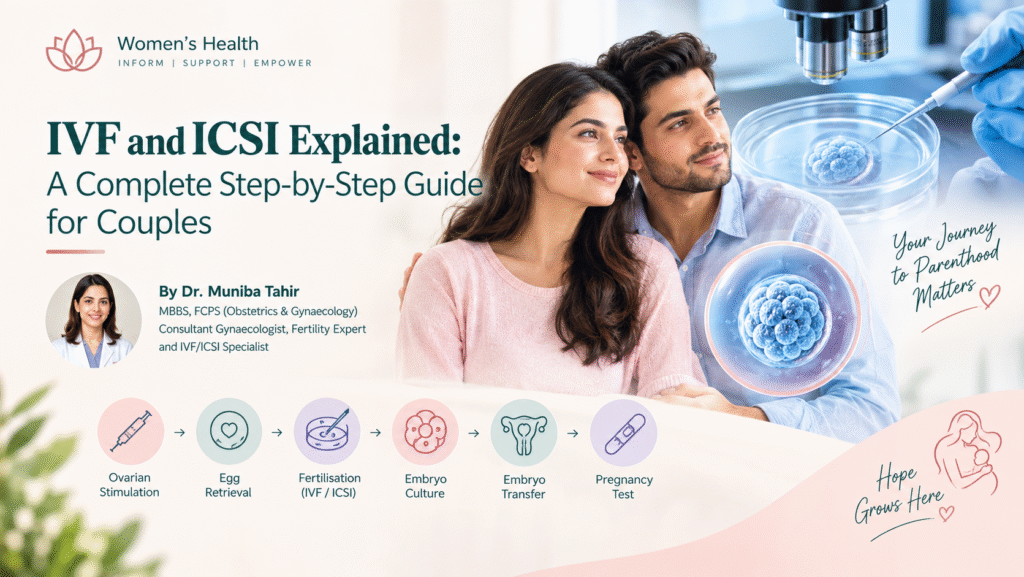
Starting IVF or ICSI can feel overwhelming. Couples are often presented with unfamiliar injections, scans, laboratory terms and decisions about embryos—all within a relatively short period.
Understanding each stage can reduce anxiety and help couples make informed decisions. Although IVF and ICSI are closely related, they are not identical. The main difference lies in how the egg is fertilised in the laboratory.
What Is IVF?
IVF stands for in vitro fertilisation. “In vitro” means that fertilisation takes place outside the body in a specialised embryology laboratory.
During IVF:
- The ovaries are stimulated to develop multiple follicles.
- Mature eggs are collected from the ovaries.
- Eggs and prepared sperm are placed together in the laboratory.
- Successfully fertilised eggs are cultured as embryos.
- A selected embryo may be transferred into the uterus or frozen for later use.
Any suitable additional embryos can be cryopreserved, depending on their development, quality and the couple’s treatment plan.
What Is ICSI?
ICSI stands for intracytoplasmic sperm injection.
The initial stages—ovarian stimulation, egg retrieval and embryo culture—are essentially the same as IVF. The difference is the fertilisation technique.
During conventional IVF, thousands of prepared sperm are placed around each egg and fertilisation is allowed to occur.
During ICSI, an embryologist selects one sperm and injects it directly into the cytoplasm of a mature egg.
ICSI improves the chance of fertilisation when the sperm is unlikely to penetrate the egg without laboratory assistance. It does not guarantee fertilisation, embryo development, implantation or pregnancy. HFEA guidance on ICSI
IVF Versus ICSI
| Feature | Conventional IVF | ICSI |
|---|---|---|
| Fertilisation | Eggs and prepared sperm are placed together | One sperm is injected into each mature egg |
| Main indication | Suitable sperm quality and number | Significant male-factor infertility or previous fertilisation difficulty |
| Egg preparation | Eggs retain surrounding cells initially | Eggs are denuded so maturity can be assessed |
| Fertilisation guarantee | No | No |
| Pregnancy guarantee | No | No |
| Benefit for every couple | No | No |
ICSI is a laboratory component of an IVF cycle, not an entirely separate course of treatment.
Who May Need IVF?
IVF may be considered for:
- Blocked, severely damaged or absent fallopian tubes
- Significant tubal damage following pelvic infection or genital tuberculosis
- Endometriosis
- Reduced ovarian reserve
- Age-related fertility decline
- Ovulation disorders not responding to simpler treatment
- Male-factor infertility
- Unexplained infertility
- Failure of appropriately selected IUI cycles
- Previous unsuccessful fertility treatment
- Fertility preservation before certain medical treatments
- Use of donated eggs or sperm
- Preimplantation genetic testing in selected cases
Not every couple experiencing infertility needs IVF immediately. Age, duration of infertility, ovarian reserve, tubal condition, semen analysis and previous treatment should all guide the decision.
When Is ICSI Recommended?
ICSI may be particularly useful when there is:
- Very low sperm count
- Poor sperm movement
- Significantly abnormal sperm morphology
- Surgically retrieved sperm
- Obstructive or non-obstructive azoospermia with sperm retrieval
- Previous complete or unexpectedly low fertilisation with conventional IVF
- Frozen sperm of limited quantity or quality
- A limited number of eggs with a significant concern about fertilisation
- Certain specialised laboratory or genetic-testing circumstances
ICSI may also be considered after individual assessment when there are combined fertility factors.
However, ICSI is not automatically better for every patient. The 2026 ASRM committee opinion reports that routine ICSI for non-male-factor infertility has not demonstrated an improvement in live-birth rates. ASRM guidance on ICSI
Step 1: Initial Fertility Consultation
Both partners should ideally be assessed because infertility may involve female factors, male factors, a combination of factors or remain unexplained.
The initial consultation generally includes:
- Duration of infertility
- Menstrual and ovulation history
- Previous pregnancies or miscarriages
- Previous fertility treatments
- Pelvic infections or tuberculosis history
- Endometriosis, fibroids or ovarian surgery
- Previous ectopic pregnancy or tubal surgery
- Medical conditions and medications
- Sexual and reproductive history
- Family and genetic history
- Lifestyle factors
- Review of previous medical records
The fertility specialist then determines whether IVF, ICSI, IUI, ovulation induction, surgery or another approach is most appropriate.
Step 2: Pre-IVF Investigations
Investigations are individualised but may include:
For the female partner
- Anti-Müllerian hormone, or AMH
- Antral follicle count by ultrasound
- Baseline FSH, LH and oestradiol where indicated
- Thyroid testing
- Prolactin when indicated
- Blood glucose or HbA1c
- Full blood count
- Blood group and infectious-disease screening
- Pelvic ultrasound
- Assessment of the uterine cavity
- Cervical screening according to age and history
- Additional hormonal or genetic testing where required
For the male partner
- Semen analysis
- Repeat semen assessment when necessary
- Infectious-disease screening
- Hormonal testing for severe sperm abnormalities
- Genetic testing in selected cases
- Sperm DNA fragmentation testing when clinically justified
- Examination or assessment by an andrologist or urologist
- Planning for surgical sperm retrieval where required
AMH and antral follicle count help predict the likely ovarian response to stimulation. They do not independently measure egg quality or guarantee pregnancy.
Female age remains one of the most important factors affecting egg quality and IVF success.
Step 3: Developing an Individualised Treatment Plan
The stimulation plan is selected according to:
- Age
- AMH and antral follicle count
- Body weight
- Previous ovarian response
- PMOS, previously called PCOS
- Endometriosis
- Previous ovarian surgery
- Risk of ovarian hyperstimulation syndrome
- Number of embryos required
- Whether PGT is planned
- Fresh versus frozen embryo-transfer strategy
Common approaches include:
Antagonist protocol
Gonadotrophin injections are started early in the menstrual cycle. An antagonist is added after several days to prevent premature ovulation.
This protocol is widely used because it is shorter and allows strategies that can reduce the risk of ovarian hyperstimulation syndrome.
Long agonist protocol
Medication is used to suppress natural hormonal activity before ovarian stimulation begins. It may be appropriate in selected patients but requires a longer treatment period.
Mild or individualised stimulation
Lower medication doses may be considered in selected women, depending on ovarian reserve, treatment history and goals.
There is no single “best” stimulation protocol or dose for every woman.
Step 4: Ovarian Stimulation
In a natural cycle, usually one follicle becomes dominant. During IVF, daily gonadotrophin injections are given to encourage several follicles to grow simultaneously.
Stimulation commonly lasts approximately 8–14 days, although the duration varies.
The injections may contain:
- Follicle-stimulating hormone
- Luteinising-hormone activity
- Human menopausal gonadotrophin
- A combination selected for the individual patient
The dose may be adjusted according to ultrasound and hormonal response.
A higher dose does not create new eggs or restore ovarian reserve. The objective is to recruit an appropriate group of follicles safely—not simply to use the maximum possible medication.
Step 5: Monitoring During Stimulation
Monitoring generally includes:
- Transvaginal ultrasound
- Measurement of follicle number and size
- Assessment of endometrial thickness
- Oestradiol or other blood tests when clinically indicated
- Review of symptoms and medication technique
Monitoring helps the specialist:
- Assess ovarian response
- Adjust medication where necessary
- Reduce the risk of premature ovulation
- Identify excessive or inadequate response
- Determine the correct timing of the final maturation trigger
Not every follicle will contain an egg, and not every retrieved egg will be mature.
Step 6: Preventing Premature Ovulation
In an antagonist cycle, medication is introduced during stimulation to prevent an early LH surge and ovulation before egg retrieval.
It is important to take this medication at the prescribed time. Missing or substantially delaying a dose can affect the cycle.
Step 7: Final Maturation or “Trigger” Injection
When an appropriate group of follicles has developed, a trigger injection is given to complete the final stage of egg maturation.
Depending on the protocol and OHSS risk, the trigger may contain:
- hCG
- A GnRH agonist
- A combination approach in selected cases
The timing must be followed precisely. Egg retrieval is generally performed approximately 34–36 hours after the trigger, before ovulation occurs.
Taking the trigger at the wrong time can affect egg maturity and retrieval.
Step 8: Egg Retrieval
Egg retrieval is also called:
- Oocyte pickup
- Ovum pickup
- OPU
- Egg collection
It is usually performed under intravenous sedation or short anaesthesia.
A transvaginal ultrasound probe guides a thin needle through the vaginal wall into each accessible follicle. The follicular fluid is aspirated and immediately examined by the embryology team for eggs.
The procedure commonly takes approximately 15–30 minutes, depending on the number and accessibility of follicles.
After egg retrieval
Temporary symptoms may include:
- Lower abdominal cramping
- Light vaginal spotting
- Bloating
- Fatigue
- Nausea related to sedation
Most patients return home the same day after observation. They should not drive or make important decisions while affected by sedation.
Severe pain, heavy bleeding, fever, difficulty breathing, fainting, persistent vomiting or rapidly increasing abdominal swelling requires urgent medical assessment.
Step 9: Semen Collection and Preparation
A fresh semen sample is usually produced on the day of egg retrieval unless frozen or surgically retrieved sperm has already been arranged.
The laboratory processes the sample to select and concentrate suitable sperm.
If sperm production may be difficult because of anxiety, travel, medical history or a previously poor sample, advance cryopreservation can be considered.
In severe male-factor infertility or azoospermia, sperm may be retrieved using a surgical technique planned with the fertility and male-infertility teams.
Step 10: Fertilisation
Conventional IVF
A measured concentration of prepared sperm is placed with each suitable egg. Fertilisation is checked the following day.
ICSI
The cells surrounding the retrieved eggs are removed so the embryologist can identify which eggs are mature.
One selected sperm is injected into each mature egg. Immature eggs generally cannot undergo standard ICSI.
The laboratory checks for normal fertilisation, commonly identified by two pronuclei.
Not every egg will:
- Be mature
- Fertilise normally
- Divide after fertilisation
- Continue developing
- Reach the blastocyst stage
- Be suitable for transfer or freezing
This natural reduction at each stage is called embryo attrition. It does not automatically mean that the laboratory or treatment has failed.
Step 11: Embryo Culture
Fertilised eggs are cultured in controlled incubators and monitored as they develop.
Embryos may be assessed at:
- Day 2 or 3: cleavage stage
- Day 5, 6 or occasionally 7: blastocyst stage
Blastocyst culture allows further assessment of developmental potential, but not every fertilised egg will reach the blastocyst stage.
Embryo grading usually considers:
- Cell division
- Symmetry
- Fragmentation
- Blastocyst expansion
- Inner cell mass
- Trophectoderm appearance
Embryo grading is a morphological assessment. It cannot guarantee normal chromosomes, implantation or a healthy live birth.
Step 12: Fresh Transfer, Freezing or Genetic Testing
Depending on the patient’s condition and treatment plan, the cycle may proceed with:
- Fresh embryo transfer
- Frozen embryo transfer in a later cycle
- Embryo freezing for fertility preservation or embryo banking
- Embryo biopsy for preimplantation genetic testing
Why might all embryos be frozen?
A freeze-all strategy may be recommended when there is:
- High risk of ovarian hyperstimulation syndrome
- Very high progesterone or an unsuitable hormonal environment
- Endometrial concern
- Fluid within the uterine cavity
- Significant illness
- Need for PGT
- Need for additional uterine assessment
- Embryo-banking plan
- Clinical concern that a later transfer may be safer or more appropriate
Freezing all embryos does not necessarily mean something has gone wrong.
What Is PGT?
Preimplantation genetic testing includes different tests for different indications.
PGT-M
Used when one or both partners carry a specific single-gene condition.
PGT-SR
Used for certain structural chromosome rearrangements.
PGT-A
Screens embryo biopsy samples for the number of chromosomes.
PGT-A may reduce miscarriage in some populations by helping select an embryo reported as euploid, but it does not improve the chance of having a baby for every patient starting IVF. It may also reduce the number of embryos available for transfer.
PGT-A does not guarantee implantation or a genetically healthy baby. Mosaic or inconclusive results can complicate decision-making, and prenatal screening or diagnostic testing may still be recommended after pregnancy. HFEA guidance on PGT-A
The potential benefits, limitations, cost and possibility of having no embryo suitable for transfer should be discussed before treatment.
Step 13: Embryo Transfer
Embryo transfer is usually a short procedure that does not require general anaesthesia.
A thin catheter is passed through the cervix, and the selected embryo is placed gently inside the uterine cavity under ultrasound guidance.
The procedure may require a comfortably full bladder to improve ultrasound visualisation and straighten the uterine angle.
Mild discomfort or pressure may be felt. Most patients can return home shortly afterwards.
Prolonged bed rest has not been shown to improve implantation. Normal light activity is generally acceptable unless the treating team gives different instructions.
How Many Embryos Should Be Transferred?
The safest goal of assisted reproduction is usually one healthy baby at a time.
The number of embryos transferred depends on:
- Female age
- Embryo stage and quality
- PGT result
- Previous treatment history
- Medical risks
- Local regulation and laboratory policy
Transferring more embryos may increase the chance of twins or higher-order multiple pregnancy. Multiple pregnancy carries increased risks of:
- Miscarriage
- Preterm birth
- Low birth weight
- Gestational diabetes
- Hypertension and pre-eclampsia
- Operative delivery
- Neonatal intensive-care admission
For many patients with a good-quality blastocyst, single-embryo transfer is preferred.
Step 14: Progesterone Support
Progesterone is prescribed to support the endometrium and early implantation.
It may be given as:
- Vaginal tablets, capsules or gel
- Intramuscular injections
- Subcutaneous injections
- Oral medication in selected protocols
- A combination of routes
Progesterone can cause bloating, breast tenderness, fatigue, discharge and symptoms resembling early pregnancy.
Medication should not be stopped because of spotting or a home pregnancy-test result unless instructed by the fertility team.
Step 15: Pregnancy Test
A blood pregnancy test measuring beta-hCG is usually performed approximately 9–14 days after embryo transfer, depending on the embryo stage and clinic protocol.
Testing too early can produce:
- A false-negative result because hCG has not risen sufficiently
- A false-positive result from an hCG trigger injection
If the test is positive, it may be repeated to assess the pattern of rise.
An ultrasound is then scheduled at the appropriate gestational age to confirm:
- Location of the pregnancy
- Number of gestational sacs
- Fetal heartbeat when expected
- Exclusion of ectopic or heterotopic pregnancy
A positive pregnancy test does not by itself confirm that the pregnancy is located inside the uterus.
How Long Does an IVF Cycle Take?
The duration depends on the protocol and whether the embryo transfer is fresh or frozen.
A typical cycle may involve:
- Preparation and testing: several weeks
- Ovarian stimulation: approximately 8–14 days
- Egg retrieval: about 34–36 hours after trigger
- Embryo culture: approximately 3–7 days
- Pregnancy testing: approximately 9–14 days after transfer
A long protocol, PGT, embryo banking or frozen transfer can extend the overall timeline over several weeks or months.
What Determines IVF or ICSI Success?
Success is influenced by:
- Female age
- Egg number and quality
- Ovarian reserve
- Sperm quality
- Cause and duration of infertility
- Embryo development
- Chromosomal competence
- Uterine and endometrial health
- Endometriosis or adenomyosis
- Hydrosalpinx
- Fibroids affecting the uterine cavity
- Smoking and other lifestyle factors
- Laboratory performance
- Previous pregnancy and IVF history
Age and egg quality
Age is one of the strongest predictors because chromosomal abnormalities in eggs and embryos become more common as maternal age advances.
AMH and ovarian reserve
A low AMH suggests that fewer eggs may be obtained during stimulation. It does not mean that pregnancy is impossible and does not directly establish the quality of an individual egg.
A high AMH may predict a strong response and a higher risk of OHSS, particularly in women with PMOS.
Risks of IVF and ICSI
Ovarian hyperstimulation syndrome
OHSS occurs when the ovaries respond excessively to stimulation. Symptoms can include:
- Increasing abdominal swelling
- Significant pain
- Nausea or vomiting
- Reduced urine output
- Rapid weight gain
- Shortness of breath
Modern antagonist protocols, individualised dosing, agonist triggers and freeze-all strategies can reduce the risk.
Multiple pregnancy
The risk is primarily related to the number of embryos transferred.
Ectopic pregnancy
An embryo can rarely implant outside the uterus even after being placed inside the uterine cavity. The risk may be higher in women with tubal disease.
Egg-retrieval complications
Bleeding, pelvic infection and injury to surrounding organs are uncommon but possible.
Cycle cancellation
A cycle may be cancelled because of poor response, excessive response, premature ovulation or another safety concern.
No egg or no mature egg
A follicle does not always contain a retrievable mature egg.
Fertilisation failure
Fertilisation may fail even with ICSI. ICSI helps overcome some sperm–egg interaction problems but cannot correct every egg- or sperm-related defect.
No transferable embryo
Some cycles produce fertilised eggs but no embryo suitable for transfer or freezing.
Miscarriage
IVF cannot eliminate miscarriage. Risk is influenced strongly by maternal age, embryo chromosomes and other maternal or pregnancy factors.
Emotional and financial stress
Treatment may affect mood, relationships, work and finances. Psychological support can be valuable, particularly after unsuccessful cycles.
Is IVF the Same as a Test-Tube Baby?
“Test-tube baby” is an informal term used for a baby conceived through IVF. Fertilisation occurs in specialised laboratory dishes and incubators—not in an ordinary test tube.
Children conceived through IVF are born in the same way as other babies, either vaginally or by caesarean according to obstetric indications.
Common IVF and ICSI Myths
“ICSI guarantees fertilisation.”
No. ICSI may increase the possibility of fertilisation in selected cases, but fertilisation can still fail.
“ICSI always gives better-quality embryos.”
No. ICSI changes how sperm enters the egg. It cannot guarantee embryo quality or correct chromosomal abnormalities.
“A high AMH means excellent egg quality.”
No. AMH primarily helps estimate egg quantity and expected ovarian response. Egg quality is influenced mainly by age.
“Low AMH means IVF cannot work.”
No. Low AMH may mean fewer eggs and possibly fewer embryos, but pregnancy can still occur.
“Bed rest after embryo transfer improves implantation.”
Routine prolonged bed rest has not been shown to improve IVF outcomes.
“A good-looking embryo must implant.”
Embryo appearance provides useful information but cannot guarantee chromosomal normality or implantation.
“IVF always causes twins.”
No. The risk of twins is reduced substantially by transferring one embryo.
“PGT-A guarantees a healthy baby.”
No. PGT-A is a screening test performed on a small embryo biopsy. It has limitations and does not test for every genetic or developmental condition.
Questions to Ask Before Starting IVF
Couples may wish to ask:
- Why are IVF or ICSI being recommended?
- Is conventional IVF appropriate, or is there a clear reason for ICSI?
- What ovarian response is expected?
- Which stimulation protocol is planned?
- What is the individual risk of OHSS?
- What happens if the response is too low or too high?
- Is fresh or frozen transfer more appropriate?
- How many embryos are recommended for transfer?
- Is PGT clinically justified?
- What costs are included?
- What happens to additional embryos?
- What is the clinic’s policy regarding storage and consent?
- What is the realistic chance of live birth for this couple?
- What is the plan if the first cycle is unsuccessful?
Final Message
IVF and ICSI involve much more than collecting eggs and transferring an embryo. Treatment begins with a careful evaluation of both partners, followed by individualised stimulation, monitoring, egg retrieval, fertilisation, embryo culture and an appropriately planned embryo transfer.
ICSI is highly valuable for significant male-factor infertility and previous fertilisation problems. However, it is not automatically superior to conventional IVF for every couple.
Success cannot be guaranteed, and each treatment cycle may produce a different number of eggs, embryos and outcomes. Transparent counselling and an individualised treatment plan are essential.
For fertility assessment, IVF/ICSI planning, low ovarian reserve, endometriosis-related infertility, male-factor infertility or previous IVF failure, schedule a consultation with Dr. Muniba Tahir, Consultant Gynaecologist and Fertility Expert in Lahore.
Practice locations: Omar Hospital, Johar Town, and National Hospital & Medical Centre, DHA Lahore. Online consultations are also available.
This article provides general educational information and does not replace personalised fertility assessment or treatment advice.