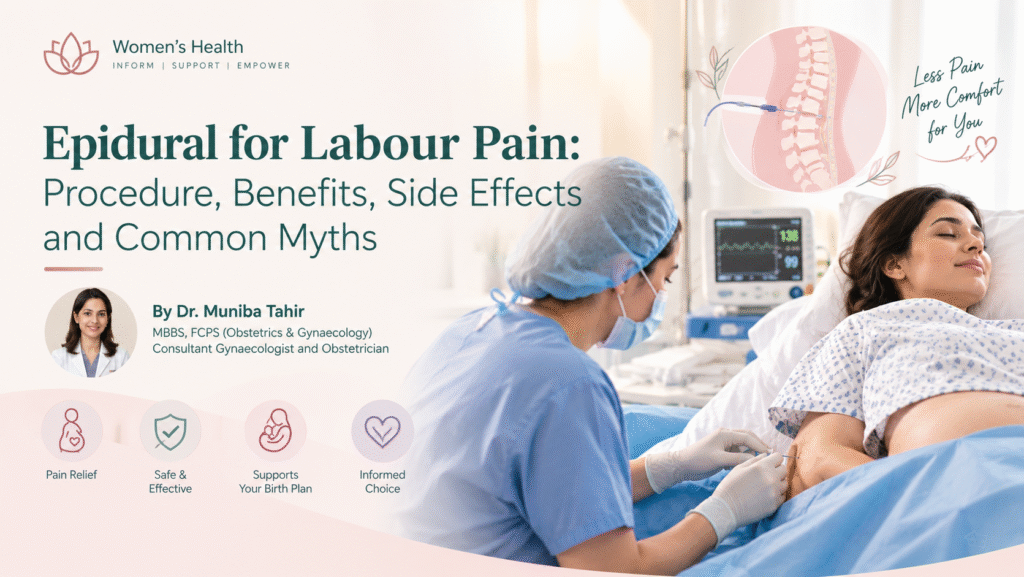
Labour pain can be intense, and every woman experiences it differently. Some women manage with breathing techniques and physical support, while others require medical pain relief.
An epidural is one of the most effective methods of controlling labour pain. Despite its widespread use and established safety, many women remain fearful because of myths about paralysis, permanent back pain, caesarean delivery and harm to the baby.
Choosing an epidural is a personal decision. Women should receive accurate information and be supported in choosing the pain-relief method that is appropriate for them.
What Is an Epidural?
An epidural is a form of regional analgesia that reduces pain from the lower part of the body while allowing the woman to remain awake and alert.
A combination of a local anaesthetic and sometimes a small dose of an opioid is given through a very thin plastic tube called an epidural catheter. The catheter is placed in the epidural space in the lower back.
The medication blocks pain signals travelling through the spinal nerves. Modern low-dose epidurals aim to provide effective pain relief while preserving some sensation, movement and the ability to participate in pushing.
The medicine is not injected into the spinal cord.
Who Administers an Epidural?
An epidural is administered by a trained anaesthetist.
Before the procedure, the anaesthetist reviews:
- Medical and pregnancy history
- Allergies
- Current medications
- Use of aspirin or blood-thinning medicines
- Recent blood results, including platelet count when indicated
- Previous spinal or back surgery
- Any history of bleeding disorders
- The mother’s blood pressure and general condition
The anaesthetist explains the benefits, limitations and possible complications before obtaining consent.
How Is an Epidural Given?
Step 1: Intravenous access and monitoring
An intravenous cannula is usually placed in the arm. The mother’s blood pressure, pulse and the baby’s heart rate are monitored.
Fluids or medication can be given through the intravenous line if the blood pressure falls.
Step 2: Positioning
The woman is usually asked to either:
- Sit on the edge of the bed and lean forward, or
- Lie on her side with her back curved
The aim is to create space between the bones of the lower back. Remaining still during needle placement is important. The anaesthetist pauses if the woman has a contraction.
Step 3: Cleaning and local anaesthetic
The lower back is cleaned with an antiseptic solution and covered with sterile drapes. A small injection of local anaesthetic is given to numb the skin.
This initial injection may sting briefly.
Step 4: Epidural needle and catheter placement
A special needle is carefully introduced into the epidural space. A thin plastic catheter is then passed through the needle.
The needle is removed completely. Only the soft catheter remains in the back and is secured with adhesive dressing.
Therefore, the commonly repeated belief that “a large needle remains inside the back throughout labour” is incorrect.
Step 5: Medication and assessment
A test dose may be given before the full epidural dose. Medication is then administered through the catheter.
Pain relief usually begins within approximately 10–20 minutes, although complete adjustment may take longer. The medicine may be given continuously, in intermittent doses or through a patient-controlled epidural system, depending on hospital practice.
The epidural can be topped up if labour continues or if an operative procedure becomes necessary.
What Does an Epidural Feel Like?
The woman may feel pressure in her back during insertion, but the skin is numbed beforehand.
As the epidural begins to work:
- Contraction pain becomes significantly reduced
- The legs may feel warm, heavy or slightly numb
- Pressure may still be felt during contractions
- Vaginal or rectal pressure may become noticeable as the baby descends
- Some movement may remain possible with a low-dose epidural
The goal is effective pain relief, not necessarily the complete removal of every sensation.
A sudden electric-shock sensation, tingling or pain during catheter placement should be reported immediately to the anaesthetist.
How Effective Is an Epidural?
An epidural is generally the most effective form of labour-pain relief. However, it is not perfect in every case.
Sometimes:
- Pain relief is incomplete
- One side becomes numb while the other remains painful
- A particular area remains uncomfortable
- The catheter moves from its original position
- Additional medication is required
- The catheter needs to be adjusted or replaced
If the epidural is not working adequately, the woman should tell her midwife, obstetrician or anaesthetist rather than continuing to suffer silently.
Benefits of an Epidural
Highly effective pain relief
An epidural usually provides stronger and more consistent pain relief than injected or intravenous opioid medication.
The mother remains awake
The woman remains conscious and can participate in the birth.
Helpful during long or difficult labour
Resting during a prolonged labour may reduce exhaustion and help the woman cope more effectively.
Medication can be adjusted
The dose can be increased, reduced or continued according to the stage of labour and the patient’s response.
Can be extended for procedures
A functioning epidural may be topped up if the woman requires:
- Forceps or vacuum-assisted delivery
- Manual removal of the placenta
- Repair of a complicated tear
- Emergency caesarean section
In some emergencies, general anaesthesia may still be required.
Limited transfer of medication to the baby
Compared with systemic opioids, relatively little epidural medication reaches the baby.
May be particularly useful in selected high-risk pregnancies
Epidural analgesia may be helpful for some women with:
- Hypertension or pre-eclampsia
- Certain cardiac conditions
- Multiple pregnancy
- Anticipated complicated delivery
- A planned VBAC
- A high probability of needing operative intervention
The decision should be individualised with the obstetric and anaesthetic teams.
Common Side Effects and Their Management
Fall in blood pressure
An epidural can lower the mother’s blood pressure. This may cause nausea, dizziness or changes in the baby’s heart rate.
Management may include:
- Positioning the mother appropriately
- Intravenous fluids
- Medication to increase blood pressure
- Oxygen or additional assessment when required
- Continuous maternal and fetal monitoring
Blood pressure is checked frequently after the epidural is started or topped up.
Heavy or weak legs
The legs may feel heavy, numb or weak, depending on the medication and dose.
The dose can sometimes be adjusted. Walking is allowed only if the maternity unit has a specific mobile-epidural protocol and staff confirm that it is safe.
Normal strength usually returns after the medication is stopped.
Difficulty passing urine
An epidural can reduce the sensation of a full bladder. A urinary catheter may be required during labour.
Normal bladder sensation usually returns after the epidural wears off.
Itching
Opioid medication used in the epidural can cause itching.
This may be treated with medication or by adjusting the epidural mixture.
Nausea
Nausea may occur, particularly if blood pressure falls.
It can usually be managed by correcting the blood pressure and giving anti-sickness medication.
Fever
Some women develop a raised temperature during a prolonged epidural. Because fever can also indicate infection, the maternity team assesses both the mother and baby and manages the situation accordingly.
Shivering
Shivering can occur during labour with or without an epidural. Warm blankets and reassurance may help.
Tenderness at the insertion site
Mild local discomfort or bruising can occur for a few days. This is different from persistent or chronic back pain.
Inadequate or one-sided pain relief
The anaesthetist may:
- Change the mother’s position
- Give an additional dose
- Withdraw or adjust the catheter slightly
- Replace the epidural
- Recommend another anaesthetic technique
Post-Dural Puncture Headache
Occasionally, the needle unintentionally punctures the membrane containing spinal fluid. This can cause a severe headache, typically:
- Worse when sitting or standing
- Better when lying flat
- Associated with neck discomfort, nausea or light sensitivity
Management may include:
- Medical assessment
- Appropriate pain medication
- Fluids and caffeine in selected cases
- An epidural blood patch when symptoms are significant or persistent
During a blood patch, a small amount of the woman’s own blood is placed in the epidural space to help seal the puncture. It is often highly effective.
Any severe headache after delivery—particularly with high blood pressure, visual symptoms, weakness, seizures or fever—requires urgent assessment because not every postpartum headache is caused by the epidural.
Rare but Serious Complications
Serious epidural complications are very uncommon but may include:
- Infection around the epidural space
- Bleeding or haematoma near the spinal nerves
- Temporary nerve injury
- Permanent nerve damage
- Severe reaction to medication
- Medication entering the wrong space or a blood vessel
- Breathing difficulties
- Seizure or cardiac complications from local-anaesthetic toxicity
Close monitoring and proper patient selection reduce these risks. Permanent paralysis from a labour epidural is exceptionally rare.
After discharge, urgent medical assessment is needed for:
- Increasing severe back pain
- Fever with redness, swelling or discharge from the injection site
- Persistent or worsening leg weakness
- New loss of bladder or bowel control
- Numbness around the perineal area
- Severe postural headache
- Confusion, seizures or breathing difficulty
Who May Not Be Able to Receive an Epidural?
An epidural may be unsuitable or require delay in women with:
- Refusal or inability to provide consent
- Significant blood-clotting disorder
- Very low platelet count, depending on the cause and trend
- Use of blood-thinning medication within an unsafe time interval
- Infection at the injection site
- Severe untreated infection in the bloodstream
- Major uncontrolled bleeding or severe circulatory instability
- Certain spinal abnormalities or previous spinal operations
- Some neurological or intracranial conditions
- Allergy to the required medication
A low platelet count does not have one universal cut-off applicable to every patient. The anaesthetist considers the actual count, trend, cause, bleeding history and clinical circumstances.
Previous back pain, a slipped disc, scoliosis, spinal surgery or a lower-back tattoo does not automatically make an epidural impossible, but an antenatal anaesthetic review may be helpful.
Common Epidural Myths
Myth 1: “An epidural always causes permanent back pain.”
Fact: Pregnancy, labour, lifting the baby and changes in posture commonly cause postpartum back pain. High-quality evidence does not show that epidurals are a major cause of long-term backache.
Temporary tenderness at the insertion site may occur.
Myth 2: “An epidural can easily cause paralysis.”
Fact: Permanent neurological injury is exceptionally rare. Anaesthetists use sterile technique, careful positioning and monitoring to minimise risk.
Myth 3: “The needle remains inside the back.”
Fact: The needle is removed immediately after the soft catheter is inserted. Only the flexible catheter stays in place.
Myth 4: “An epidural medication is injected into the spinal cord.”
Fact: The catheter is placed in the epidural space outside the membrane containing the spinal fluid. It is not placed inside the spinal cord.
Myth 5: “An epidural automatically causes caesarean delivery.”
Fact: Current evidence does not show that modern labour epidurals increase the overall likelihood of caesarean birth. The Royal College of Anaesthetists states that epidurals do not make caesarean or instrumental birth more likely. Royal College of Anaesthetists guidance
Women with prolonged or complicated labour are more likely to request epidural analgesia and are also more likely to require intervention because of the underlying labour problem—not necessarily because of the epidural.
Myth 6: “You cannot push after an epidural.”
Fact: Most women can still feel pressure and follow instructions during pushing. The medication can be adjusted if the block is too dense.
Myth 7: “An epidural will make the baby unconscious.”
Fact: Most epidural medication acts close to the spinal nerves, and only a relatively small amount enters the mother